Is 4 weeks notice the same as 1 month in the UK?
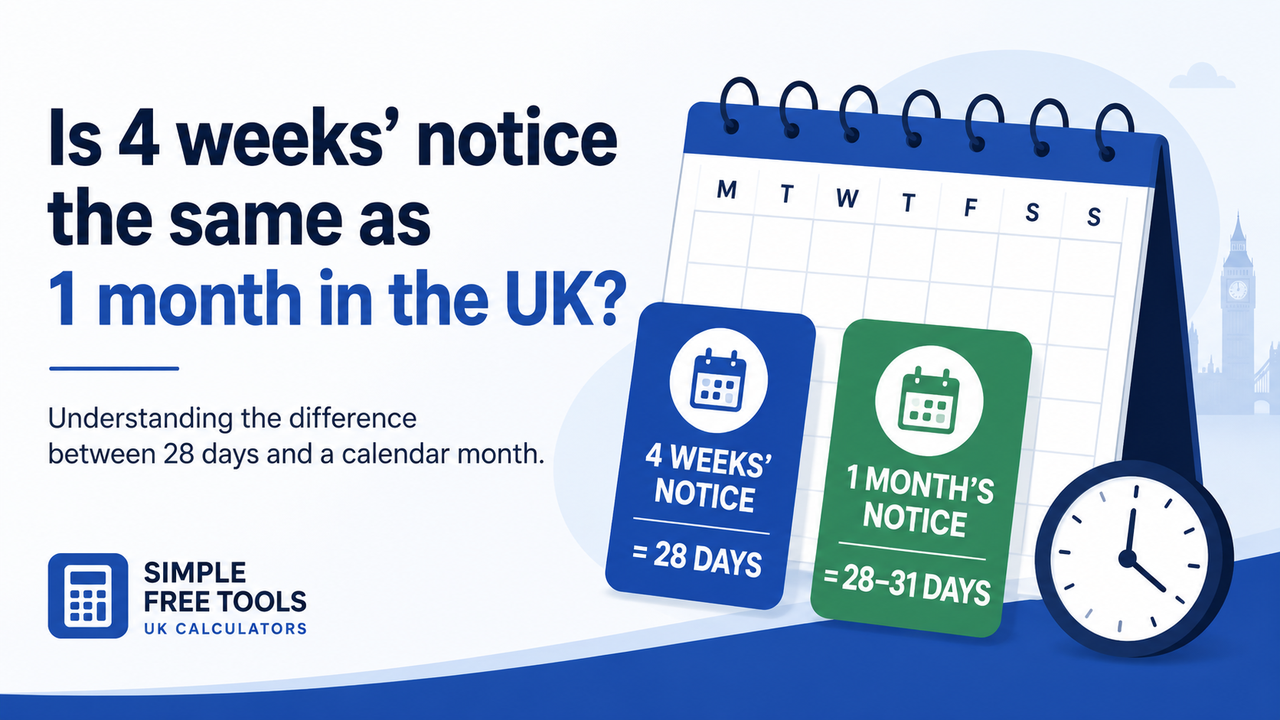
No. 4 weeks is exactly 28 days. One calendar month is 28, 29, 30, or 31 days depending on which month your notice falls in. That difference can mean up to 3 extra days of pay.
| Contract wording | What it means | Notice length |
|---|---|---|
| 4 weeks’ notice | Four 7-day weeks | Always 28 days |
| 1 month’s notice | One calendar month | 28, 29, 30, or 31 days |
| Calendar month’s notice | One calendar month, usually counted from the day after notice is given | 28, 29, 30, or 31 days |
If your contract says 1 calendar month, use the article below to count the date manually.
Here is what the difference means in practice.
Why 4 weeks and 1 month are not the same
4 weeks means 7 days multiplied by 4. That is 28 days. Every time.
1 calendar month usually runs to the day before the same date in the following month:
- Notice starts 1 January: ends 31 January (31 days)
- Notice starts 1 March: ends 31 March (31 days)
- Notice starts 1 April: ends 30 April (30 days)
- Notice starts 1 February: ends 28 February in a normal year, 29 February in a leap year
The same contract, the same wording, produces different amounts of time depending on when you hand in your notice. If your employer pays you in lieu of notice (PILON) instead of having you work it out, those extra days are real money.
What UK employment law says
UK statutory notice is measured in weeks, not months. Under the Employment Rights Act 1996, the minimum notice your employer must give you depends on how long you have worked there:
| Length of service | Minimum notice from your employer |
|---|---|
| Less than 1 month | None |
| 1 month to under 2 years | 1 week |
| 2 complete years | 2 weeks |
| 3 complete years | 3 weeks |
| 4 complete years | 4 weeks |
| Each year up to 12 | +1 week |
| 12 or more complete years | 12 weeks (maximum) |
If you are the one resigning, GOV.UK says you must give at least 1 week’s notice if you have been in your job for more than a month. That stays at 1 week regardless of how long you have been there, unless your contract says more.
Sources: gov.uk/redundancy-your-rights/notice-periods (employer notice) and gov.uk/handing-in-your-notice/giving-notice (resignation).
Which applies: statutory or contractual?
Whichever is higher.
If your contract says 4 weeks but you have worked 6 years, your statutory entitlement is 6 weeks. Your employer must give you 6 weeks. The contract cannot give you less than the statutory minimum.
If your contract says 8 weeks and your statutory entitlement is 6 weeks, you are owed 8 weeks. The higher figure always wins.
The notice period calculator handles this automatically. Enter your contractual notice in weeks alongside your dates, and it picks the higher figure.
One thing most people get wrong
Your notice period usually does not start on the day you hand in your notice. GOV.UK says it usually runs from the start of the day after you hand it in.
ACAS gives the more precise rule for employees: if your contract does not say when notice starts, it starts the day after you tell your employer you are resigning. If your employer gives notice in writing, the period starts when you have had a reasonable amount of time to read it.
Resign on a Monday and your notice period usually begins on Tuesday.
This shifts your last working day by one day. If you have agreed a start date with a new employer, that one day matters. The calculator accounts for this so you do not have to.
Sources: gov.uk/handing-in-your-notice/giving-notice and acas.org.uk/notice-periods/when-the-notice-period-starts.
Worked example: 3 years of service, 1 month contractual notice
You have worked at a company for 3 years and 2 months. Your contract says “1 month’s notice.” You hand in your resignation on 15 May.
Step 1: Statutory notice. You are resigning, so the statutory minimum is a flat 1 week once you have at least 1 month of service. Years of service do not increase this. Statutory: 1 week.
Step 2: Contractual notice. Your notice period starts 16 May (the day after). One calendar month from 16 May = 15 June.
Step 3: Contractual notice beats statutory notice. A calendar month from 16 May is longer than the 1-week statutory minimum, so your last working day is 15 June.
The notice period calculator takes contractual notice in weeks, so it works directly for contracts worded as “4 weeks.” For this example, it confirms the statutory entitlement (1 week). The calendar-month date (15 June) comes from counting one month forward from the day after notice was given, which you can do manually or verify with your employer.
What to check in your contract
The exact wording in your contract determines how your notice period is measured. Common phrasings and what they mean:
- “4 weeks’ notice”: exactly 28 days. Straightforward to calculate.
- “one month’s notice” or “1 month’s notice”: a calendar month from the day after notice is given. The length varies by month.
- “calendar month’s notice”: same as above, but makes the calendar-month intent explicit.
- “one month ending on the last day of the month”: less common, but some contracts specify this. Notice given on any day in May would end on 30 June in this case.
Also check whether your contract includes a PILON (payment in lieu of notice) clause. If it does, your employer can end your employment immediately and pay you the equivalent of your notice period instead of having you work it. The calculation in that case is based on your contractual notice length, so whether it says “4 weeks” or “1 month” affects the amount you receive.
A garden leave clause has a similar effect: you stop attending work but remain employed (and paid) for the duration of your notice period.
If your contract is silent on notice, the statutory minimum applies.
This article is for information only and does not constitute legal or financial advice. If you need specific guidance, consult a licensed professional.
Last verified: