UK Notice Period Rules: Statutory vs Contractual Notice Explained
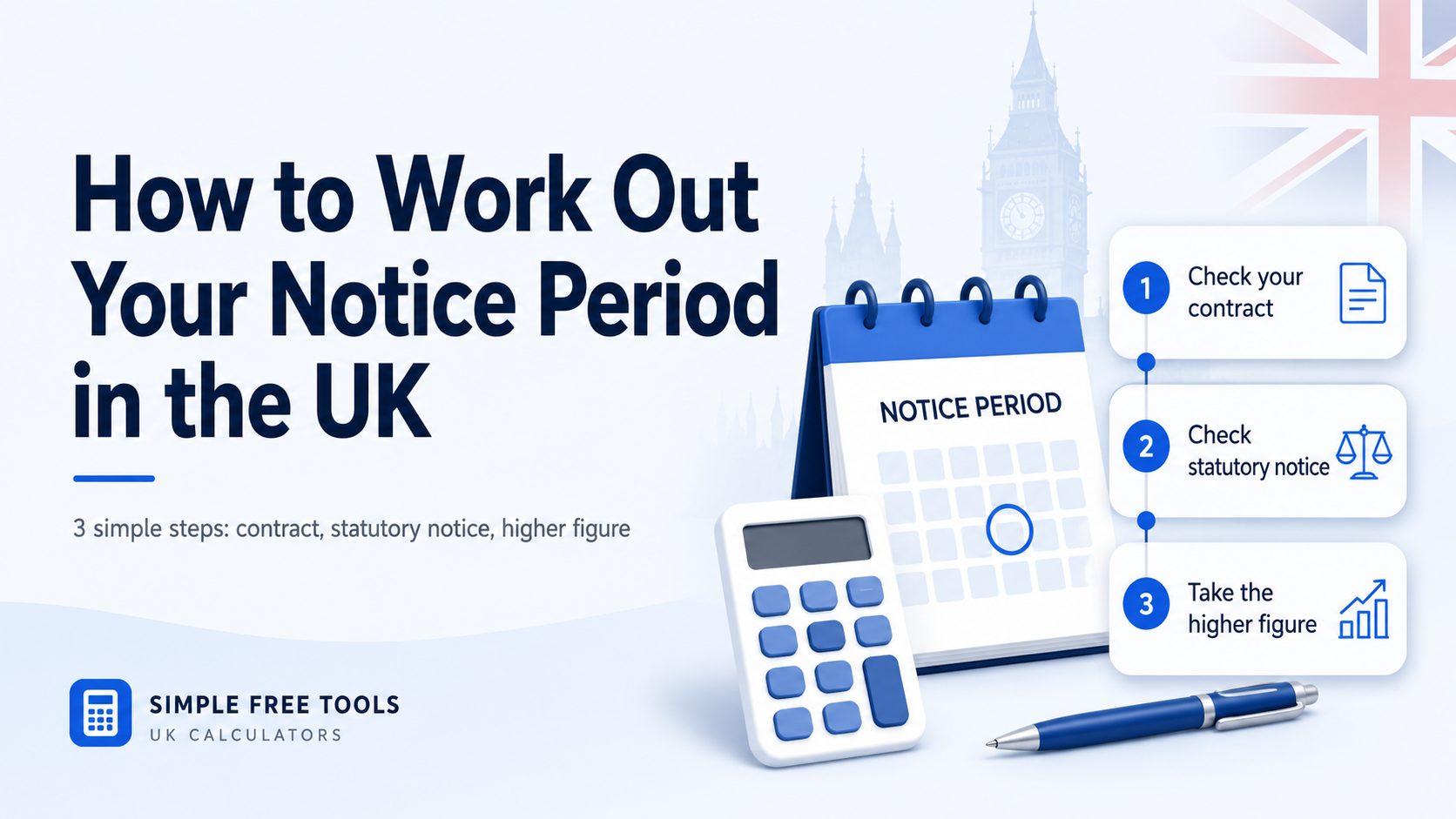
Your notice period is whichever is longer: what your contract says, or the statutory minimum set by law. This article explains how each is determined and which one applies in your situation. If you already know both figures and want your exact last working day, use the UK notice period calculator.
Step 1: check what your contract says
Look at your employment contract, staff handbook, or original offer letter. Most contracts state notice in weeks or months. Common phrasings:
- “Four weeks’ notice”: exactly 28 days, no variation
- “One month’s notice” or “1 month’s notice”: a calendar month, which is 28 to 31 days depending on when notice starts. These are not the same as 4 weeks.
- “Three months’ notice”: three calendar months from the day after notice is given
If your contract says nothing about notice, the statutory minimum applies by default.
If your contract says “1 month” or “3 months,” do not treat that as exactly 4 or 13 weeks when counting to your final date. A calendar month is 28 to 31 days depending on when it starts. Check your statutory minimum first, then count the calendar-month period from the day after notice is given.
Step 2: find your statutory entitlement
Statutory notice is the legal minimum under the Employment Rights Act 1996. The amount depends on who is giving notice and how long the employee has worked there.
If your employer is giving you notice (redundancy or dismissal):
| Length of service | Minimum notice your employer must give |
|---|---|
| Less than 1 month | None |
| 1 month to under 2 years | 1 week |
| 2 complete years | 2 weeks |
| 3 complete years | 3 weeks |
| 4 complete years | 4 weeks |
| Each additional year up to 12 | +1 week |
| 12 or more complete years | 12 weeks (maximum) |
If you are resigning:
You owe your employer 1 week of notice once you have worked there for more than 1 month. This stays at 1 week no matter how many years you have been there, unless your contract says more.
Sources: gov.uk/redundancy-your-rights/notice-periods (employer notice) and gov.uk/handing-in-your-notice/giving-notice (resignation notice), last verified June 2026.
Step 3: take whichever figure is higher
Your employer cannot give you less than your statutory entitlement. If your contract offers less than the statutory minimum, the statutory minimum takes over. If your contract offers more, the contract applies.
A few examples to make the rule concrete:
- You have worked 5 years (statutory: 5 weeks). Your contract says 4 weeks. Your employer must give you 5 weeks.
- You have worked 5 years (statutory: 5 weeks). Your contract says 8 weeks. Your employer must give you 8 weeks.
- You have worked 18 months (statutory: 1 week). Your contract says 4 weeks. Your employer must give you 4 weeks.
Your employer cannot override this rule by putting a lower figure in your contract. The law sets the floor.
When does the notice period actually start?
Not on the day you give or receive notice.
ACAS confirms that if your contract does not say when notice starts, the period begins the day after notice is given. Resign on a Monday and your notice period starts on Tuesday.
This shifts your last working day forward by one day. If you have agreed a start date with a new employer, that single day matters. Count forward from the day after you give notice, not from the day itself.
Source: acas.org.uk/notice-periods/when-the-notice-period-starts.
Worked examples
Example 1: employer giving notice
Priya has worked at a company for 5 years and 3 months. Her contract states 4 weeks’ notice. Her employer gives her notice in person on 10 June.
- Statutory entitlement: 5 complete years = 5 weeks
- Contractual notice: 4 weeks
- 5 weeks is higher, so 5 weeks applies
- Notice period starts: 11 June
- Last working day: 15 July
Example 2: employee resigning
James has worked at a company for 2 years. His contract says 3 months’ notice. He hands in his resignation on 3 June.
- Statutory minimum when resigning: 1 week
- Contractual notice: 3 calendar months
- 3 months is higher, so the contract applies
- Notice period starts: 4 June
- Last working day: 3 September
For calendar-month contracts (1 month, 3 months), count forward by calendar months from the day after notice is given, not by weeks.
What if you are in your first month?
If you have been employed for less than a month, neither party has a statutory notice obligation by default. Your employer may be able to end your employment on the day. Check your contract for a probationary period clause: many include a short notice period of 1 week even during the first month.
This article is for information only and does not constitute legal or financial advice. If you need specific guidance, consult a licensed professional.
Last verified: